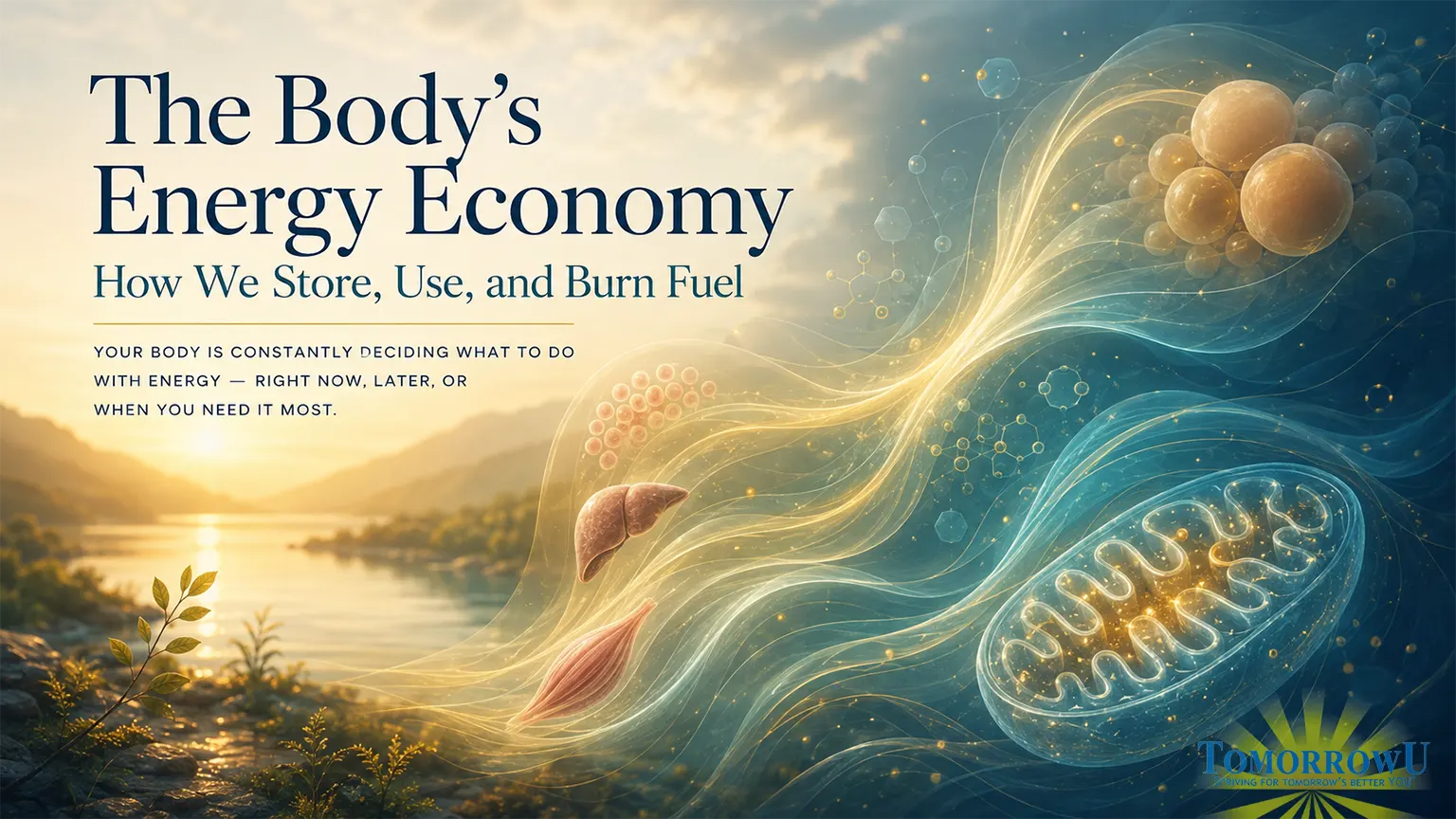
You finish a meal, return to your day, and probably give little thought to where that food goes next. Some of its energy may be used within hours. Some may be tucked away in your liver or muscles. Some may eventually be stored as body fat. Later, while you sleep, walk, work, or go several hours without eating, those stored reserves can begin moving in the other direction.
None of this requires conscious thought. Yet throughout every day, the body is continuously answering a basic question: What should I do with the energy available right now?
The answer changes from moment to moment.
After a meal, the body is generally better supplied with incoming fuel. Between meals and overnight, it relies more heavily on stored energy. During movement, working muscles suddenly need more. During prolonged inactivity, demand falls. Hormones, muscles, the liver, fat tissue, and mitochondria all participate in coordinating these shifts.
This is the body’s energy economy.
Like any economy, it depends on supply, storage, demand, and the ability to move resources where they are needed. Metabolic health is influenced not simply by how much energy enters the body, but by how effectively that energy can be received, stored, released, and used.
Understanding this makes something that can seem complicated much easier to see: the same nutrients can serve very different purposes depending on what the body needs when they arrive.
Food Does Not Stay Food for Long
Once food enters the digestive system, it begins being broken into smaller components the body can absorb and use. Carbohydrates are largely broken into glucose and other simple sugars. Dietary fats are processed into fatty acids and related molecules. Proteins provide amino acids that help build and repair tissues and make enzymes, hormones, and other essential compounds. Under certain circumstances, amino acids can also contribute to energy production.
These nutrients do not travel to one destination. They enter a network of possible pathways.
Glucose, for example, can be used relatively quickly to help cells produce energy. It can also be linked together and stored as glycogen, primarily in the liver and skeletal muscles. When energy availability exceeds immediate needs and short-term storage demands, some of that energy can ultimately contribute to longer-term storage as body fat.
Fat moves through its own pathways. Fatty acids may be used for energy, incorporated into cell structures and signaling molecules, or stored in adipose tissue for later use.
The body therefore does not have one simple fuel tank. It has overlapping energy reserves that serve different purposes and become available under different conditions.
That arrangement solves an essential biological problem: energy demand is never perfectly synchronized with eating. The brain, heart, muscles, liver, and other tissues still require energy while you sleep, between meals, and during physical activity. Storage allows the body to separate the timing of eating from the timing of need.
The body does not simply store energy. It keeps energy available for a future it cannot precisely predict.
Glucose: Useful Fuel, Carefully Managed
Glucose receives enormous attention in discussions of metabolic health, usually because of its connection to blood sugar. But glucose is not inherently harmful. It is an important fuel and a normal part of human physiology.
The challenge is managing it well.
After a carbohydrate-containing meal, glucose begins entering the bloodstream. The pancreas responds partly by releasing insulin. Insulin helps coordinate what happens next, including increasing glucose uptake in important tissues, encouraging the storage of available nutrients, and reducing some of the processes that release stored energy while incoming fuel is plentiful.
Insulin is sometimes described as a key that opens cells to glucose. The analogy is useful, but incomplete. Insulin also acts more broadly as a signal that helps the body respond to the fed state.
That distinction matters.
The body is not trying to remove glucose from the bloodstream because glucose itself is something to fear. It is regulating where that fuel goes while keeping blood glucose within an appropriate range.
When this system is functioning effectively, glucose rises after eating, tissues respond, fuel is distributed or stored, and the body gradually shifts toward drawing more heavily on stored energy as the hours pass.
For now, that is the important part of insulin to understand: it helps coordinate the movement of available fuel.
What happens when tissues become less responsive to that signal belongs to the next part of this story.
Glycogen: Energy Kept Close at Hand
One important destination for glucose is glycogen.
Glycogen consists of many glucose molecules linked together in a form the body can access relatively quickly. It is stored mainly in skeletal muscle and the liver, but those reserves serve different purposes.
Liver glycogen helps support blood glucose when incoming food is no longer providing enough glucose to meet ongoing needs. Muscle glycogen, in contrast, is largely reserved for the muscle that stores it, providing readily accessible fuel when that muscle contracts.
Imagine eating dinner and then not eating again until breakfast. The body does not simply run out of fuel during the night. Liver glycogen contributes to maintaining circulating glucose, while stored fat also supplies increasing amounts of energy as the hormonal environment changes and time passes after the meal.
Now imagine climbing several flights of stairs or starting a demanding workout. The situation changes immediately. Contracting muscles need substantially more energy, and muscle glycogen can help meet that demand without waiting for another meal to arrive.
The mixture of fuels being used is not fixed. Exercise intensity and duration, fitness, recent food intake, glycogen availability, and other factors can all influence how heavily the body draws on carbohydrate or fat at a particular moment.
The body is doing something much more dynamic than simply “burning calories.” It is continually matching available fuels to changing demands.
Muscle Changes the Demand Side
Most people think about skeletal muscle in terms of strength, appearance, or mobility. From an energy perspective, muscle is also one of the body’s most important places for glucose disposal, a major storage site for glycogen, and a tissue capable of dramatically changing its fuel needs.
Every time muscle contracts, demand changes.
This helps explain why movement has metabolic consequences even when the number of calories burned seems modest. Working muscle needs fuel. Exercise can increase muscle glucose uptake through pathways that are not completely dependent on insulin, and regular physical activity can improve insulin sensitivity and alter the cellular machinery muscles use to produce energy.
The opposite condition helps reveal just how responsive muscle can be.
In a controlled 2024 human bed-rest study, prolonged inactivity was associated with reduced insulin sensitivity and metabolic flexibility, along with changes involving muscle glycogen, lipids, glucose transport, and mitochondrial structure and function. Bed rest is far more extreme than spending too much time at a desk, so the findings should not be treated as a direct model of ordinary sitting. They do, however, demonstrate how strongly human skeletal muscle metabolism responds when its normal demand is dramatically reduced.
Muscle is therefore more than tissue that makes exercise possible. Maintaining and using it preserves part of the body’s capacity to receive, store, and spend fuel.
Metabolic health depends not only on the fuel we take in, but also on the capacity we maintain to use it.
Fat Is the Long-Term Reserve
Glycogen is valuable because it can be accessed readily, but its storage capacity is limited. Fat provides a much larger long-term energy reserve.
That ability is normal and necessary.
Stored body fat allows energy collected when food is available to remain accessible when incoming energy does not match immediate demand. Between meals, overnight, and during many forms of prolonged activity, stored fatty acids can contribute substantially to the body’s energy needs.
This also gives us a clearer way to understand visceral fat, the focus of the previous Wellness Insight.
Fat storage itself is not evidence that the body has done something wrong. Adipose tissue performs necessary biological functions. Concern grows when energy storage chronically exceeds what tissues can manage well, particularly when excess fat accumulates in metabolically important locations such as the liver and abdominal cavity.
Visceral fat can therefore be understood as part of a larger metabolic picture rather than as an isolated problem. Genetics, overall energy balance, physical activity, muscle mass, sleep, age, hormones, medications, diet, and other influences can all affect where energy is stored and how effectively it is used.
This is one reason body weight alone gives an incomplete picture.
Two people can weigh the same while differing substantially in muscle mass, visceral fat, liver fat, fitness, and insulin sensitivity. The scale tells us how much mass is present. It cannot tell us how effectively the energy systems underneath that number are functioning.
Mitochondria: Turning Fuel Into Usable Energy
Eventually, stored or circulating fuel has to become energy cells can actually use.
That brings us to mitochondria.
Often called the powerhouses of the cell, mitochondria help convert energy derived from nutrients into adenosine triphosphate, or ATP. ATP provides immediately usable energy for an enormous range of cellular work, including muscle contraction, maintaining electrical gradients across cell membranes, and supporting basic tissue function.
Mitochondria are especially abundant in tissues with substantial energy requirements, including the heart and skeletal muscle.
They are not simply tiny furnaces burning whatever fuel happens to arrive. Cellular energy production is highly regulated, and fuel selection changes as conditions change.
During many lower-intensity activities, fat can make a substantial contribution to energy production. As exercise intensity increases, the body generally relies more heavily on carbohydrate because it can support the rapid production of ATP needed for harder work. Regular exercise also produces adaptations within skeletal muscle, including changes in mitochondrial content and function that improve its ability to meet repeated energy demands.
This ability to alter fuel use rather than depend rigidly on one source is one of the most important features of a healthy energy economy.
Metabolic Flexibility: The Ability to Shift
A healthy metabolism is not one that burns fat all the time.
It is not one that avoids carbohydrates.
And it is not one that prevents glucose or insulin from ever rising.
Healthy metabolism requires movement between states.
Metabolic flexibility describes the ability to adjust fuel use as circumstances change. After eating carbohydrate, the body should be able to increase glucose use and storage appropriately. As time passes after a meal, it should become increasingly capable of drawing from stored energy. When physical activity begins, fuel demand changes again. If the intensity increases, the preferred mixture of fuels can change with it.
Rather than asking which fuel is best, it may be more useful to think about whether the body can shift appropriately between them.
A car does not become more capable by staying permanently in one gear. Different conditions require different gears, and usefulness comes from being able to change when the road demands it.
The same principle helps clarify metabolic flexibility.
Reduced metabolic flexibility is frequently observed alongside obesity, insulin resistance, and type 2 diabetes, although the relationships are complex and cannot be attributed to one mechanism or behavior. Physical inactivity can also diminish aspects of metabolic flexibility, while exercise training creates extensive adaptations that improve the ability of skeletal muscle to respond to changing energy demands.
The goal is therefore not permanent fat burning or permanent carbohydrate restriction.
It is metabolic range.
A resilient metabolism is not locked into one fuel. It is prepared to change when the body’s needs change.
Everyday Choices Change the Economy
Once this energy economy becomes visible, familiar health behaviors begin to look different.
Consider a walk after a meal.
It is easy to think of walking only in terms of calories burned. But muscles contracting soon after eating create an immediate demand for fuel during a period when nutrients are entering circulation. Research examining post-meal exercise has found that activity after eating can reduce the size of the post-meal glucose rise, although the effect varies with timing, activity, the meal itself, and the individual.
That does not mean glucose should never rise after a meal. A temporary increase is normal. Nor does it mean everyone needs to walk after every meal.
The more useful lesson is simpler: muscles handle fuel differently when they are being used.
Resistance training contributes in another way by helping build or preserve muscle tissue capable of storing glycogen and using substantial amounts of fuel. Aerobic activity places different demands on muscle and encourages adaptations in its energy-producing machinery. Ordinary movement throughout the day repeatedly gives muscle a reason to participate in the energy economy.
Food influences the other side of the equation.
A meal containing protein, fiber-rich plants, minimally processed carbohydrates, and nourishing fats generally delivers nutrients differently from one dominated by highly refined, rapidly digested foods. Food structure, portion size, nutrient combination, previous activity, sleep, medications, and an individual’s metabolic health can all influence the response.
The point is not to turn every meal into a metabolic calculation.
It is to recognize that supply and demand are constantly interacting.
Daily movement increases demand. Muscle expands the body’s capacity to handle fuel. Nutritious meals influence the amount and form in which that fuel arrives. Sleep and recovery also affect systems involved in glucose regulation and appetite.
Over time, those ordinary conditions help shape the environment in which metabolism has to operate.
More Than an Energy Equation
The energy economy metaphor is useful, but the human body is not a spreadsheet.
Energy balance matters. Over time, changes in stored energy reflect the relationship between energy entering the body and energy being expended. But that principle alone does not explain the complex biology influencing appetite, absorption, expenditure, storage, fuel preference, and spontaneous activity.
Genetics matter. Age matters. Hormonal changes, medications, illness, sleep, stress, food access, socioeconomic conditions, and the surrounding environment can all influence how that energy balance is regulated and experienced.
Two people can make similar choices and experience different outcomes. The same person can respond differently at different stages of life.
Recognizing that complexity does not make personal choices unimportant. It places them in the right context.
Supporting metabolic health is less about controlling every pathway and more about maintaining the body’s capacity to respond: using muscles regularly, preserving strength, eating in ways that generally provide useful nutrition without chronically overwhelming energy needs, sleeping adequately, and seeking appropriate medical care when metabolic disease or medications change the picture.
There is no requirement for metabolic perfection.
The more realistic goal is maintaining capacity.
Wellness Wrap-Up
Think again about the meal at the beginning of this article.
Once you finish eating, the food does not simply become “calories.” Its components enter a living system that has to decide what is needed now, what can be stored nearby, what belongs in longer-term reserves, and when those reserves should be brought back into circulation.
Glucose moves. Insulin helps coordinate its handling. Glycogen is stored and released. Fat moves into storage and can later move back out. Muscle creates changing demand. Mitochondria help turn available fuel into usable energy.
Much of this happens without us ever noticing.
Seeing it changes the meaning of familiar health advice. Movement is not simply a way to burn calories. Muscle is not only about strength. Body fat is not merely a number on the scale. Food is not just energy entering the body.
Each participates in the body’s ongoing effort to match fuel with need.
And beneath all of them is an ability worth preserving: the ability to adjust when circumstances change.
That brings us naturally to the next question. Insulin can signal that fuel is available, but what happens when the tissues receiving that signal begin responding less effectively?
That is where insulin resistance begins.
Striving for tomorrow’s better YOU!
References
- Eggelbusch, M., Charlton, B. T., Bosutti, A., Ganse, B., Giakoumaki, I., Grootemaat, A. E., Hendrickse, P. W., Jaspers, Y., Kemp, S., Kerkhoff, T. J., Noort, W., van Weeghel, M., van der Wel, N. N., Wesseling, J. R., Frings-Meuthen, P., Rittweger, J., Mulder, E. R., Jaspers, R. T., Degens, H., & Wüst, R. C. I. (2024). The impact of bed rest on human skeletal muscle metabolism. Cell Reports Medicine, 5(1), 101372. https://doi.org/10.1016/j.xcrm.2023.101372
- Engeroff, T., Groneberg, D. A., & Wilke, J. (2023). After dinner rest a while, after supper walk a mile? A systematic review with meta-analysis on the acute postprandial glycemic response to exercise before and after meal ingestion in healthy subjects and patients with impaired glucose tolerance. Sports Medicine, 53(4), 849–869. https://doi.org/10.1007/s40279-022-01808-7
- Martin, R. A., Viggars, M. R., & Esser, K. A. (2023). Metabolism and exercise: The skeletal muscle clock takes centre stage. Nature Reviews Endocrinology, 19, 272–284. https://doi.org/10.1038/s41574-023-00805-8
- Smith, J. A. B., Murach, K. A., Dyar, K. A., & Zierath, J. R. (2023). Exercise metabolism and adaptation in skeletal muscle. Nature Reviews Molecular Cell Biology, 24(9), 607–632. https://doi.org/10.1038/s41580-023-00606-x
Note: Always consult with a healthcare professional before making significant changes, especially if you have existing health conditions.