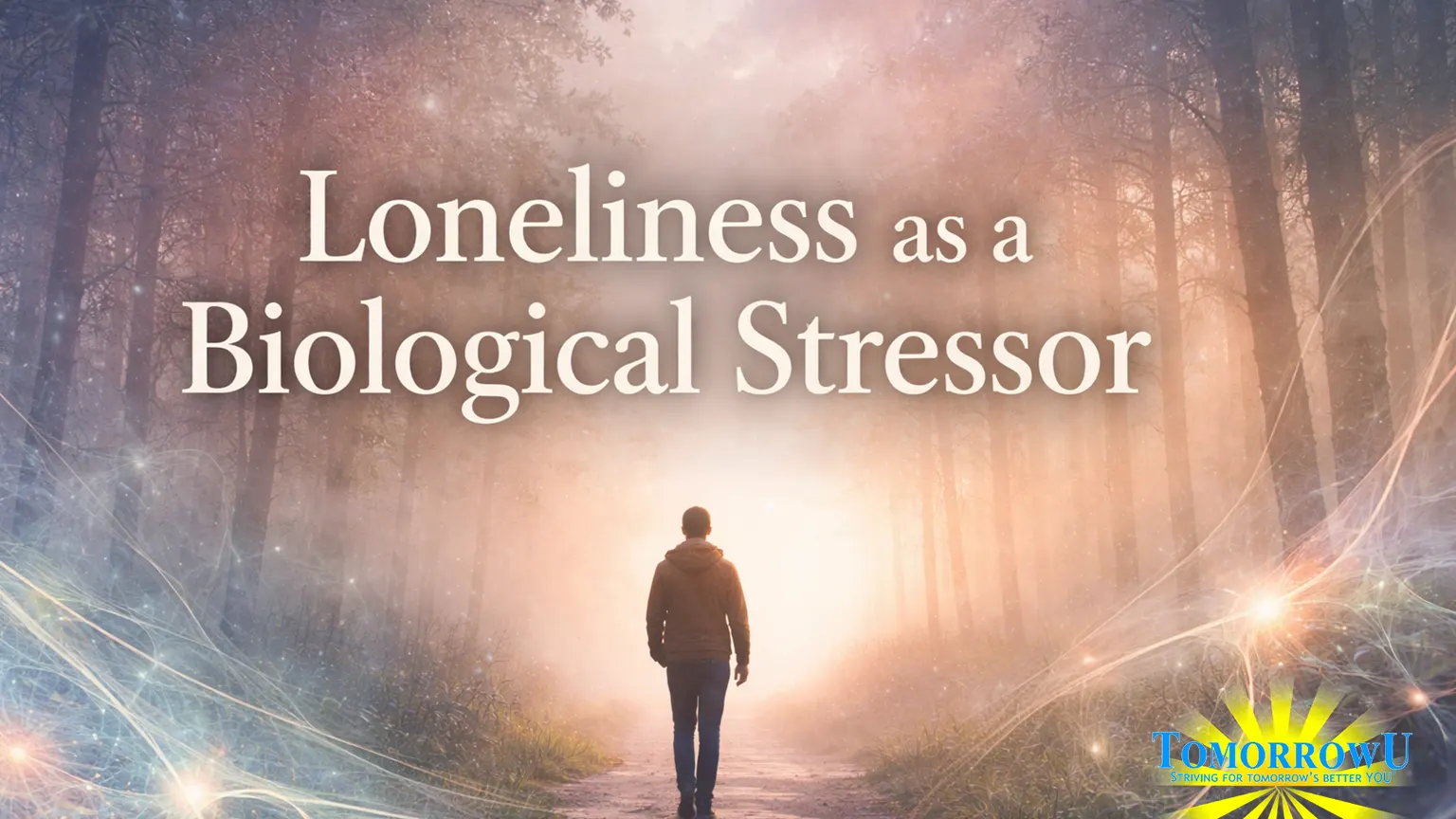
Loneliness is often described as an emotional state or a social circumstance—something shaped by relationships, personality, or life transitions. Yet beneath these familiar narratives lies a quieter and more consequential reality: loneliness functions as a biological stressor.
This is not metaphorical. The body responds to perceived isolation with measurable physiological changes that influence inflammation, sleep quality, immune signaling, pain perception, energy regulation, and the pace of biological aging. These responses unfold regardless of how socially active someone appears, how “functional” life looks from the outside, or how capable a person feels internally.
From a biological perspective, loneliness is not defined by the number of people around us. It is defined by whether the nervous system detects reliable relational safety.
When that signal weakens, the body adapts—quietly, efficiently, and often without conscious awareness.
From Social Experience to Physiological Signal
Human physiology evolved in deeply relational environments. For most of our evolutionary history, survival depended on proximity, attunement, and shared vigilance. Isolation increased vulnerability—to predators, injury, illness, and environmental exposure.
Because of this history, the nervous system does not treat loneliness as neutral. It treats it as information.
Perceived isolation activates internal monitoring systems designed to preserve life when external support is uncertain. This activation does not require sadness, distress, or even conscious dissatisfaction. It operates beneath awareness, subtly adjusting baseline tone across multiple physiological systems.
Loneliness, then, is not primarily a feeling. It is a context signal—a biological assessment of safety, predictability, and support.
Perceived Isolation vs. Objective Isolation
One of the most misunderstood aspects of loneliness is that perception matters more than circumstance.
Objective isolation refers to physical or social separation. Perceived isolation reflects whether the nervous system experiences connection as reliable, attuned, and non-threatening. These two states do not always align.
A person may live alone and feel biologically settled. Another may be surrounded by people and still experience chronic physiological loneliness. The nervous system does not respond to proximity; it responds to attunement, predictability, and non-demanding presence.
This helps explain why loneliness can persist in marriages, workplaces, families, and communities. When interactions require constant self-monitoring, emotional labor, or performance, the body remains guarded—even in company.
Biological loneliness arises not from being alone, but from being unmet at the level of regulation.
Loneliness and the Stress Response System
One of the earliest systems affected by loneliness is the stress response network, including the autonomic nervous system and the hypothalamic–pituitary–adrenal (HPA) axis.
When relational safety feels unreliable, the body shifts into a low-grade vigilance state. Sympathetic nervous system activity remains elevated at rest. Parasympathetic recovery becomes less efficient. Cortisol rhythms flatten rather than rising and falling predictably across the day.
This pattern differs from acute stress. There is no obvious trigger or resolution—only a persistent background alertness that quietly consumes energy.
Over time, this increases allostatic load, the cumulative physiological cost of constant adaptation. Energy is diverted toward monitoring and readiness instead of repair, digestion, immune recalibration, and tissue maintenance.
Loneliness does not trigger alarm. It sustains alertness.
Inflammation as Anticipatory Defense
One of the most consistent biological signatures of loneliness is its association with chronic, low-grade inflammation.
Rather than presenting as dramatic immune activation, loneliness is linked to subtle elevations in inflammatory tone—particularly markers such as IL-6, CRP, and suPAR—along with increased activation of stress-related transcription pathways. Importantly, these patterns appear independent of overt illness and are observed across age groups and life stages.
Loneliness does not simply worsen inflammation in those who are already sick. It raises baseline inflammatory readiness even in people who otherwise appear healthy.
This reflects a key distinction: anticipatory inflammation differs from acute inflammatory response.
Acute inflammation is event-driven. It rises in response to injury or infection and resolves when the threat passes. Loneliness-related inflammation, by contrast, is quiet, sustained, and diffuse. It does not flare dramatically. It lingers.
The immune system behaves as though threat might occur—maintaining readiness without resolution.
Over time, this low-grade inflammatory environment contributes to cardiovascular disease, metabolic dysregulation, mood disorders, and neurodegenerative risk—not because the body is malfunctioning, but because it is operating under sustained uncertainty.
Immune Signaling Tradeoffs in Isolation
Beyond inflammation, loneliness reshapes how the immune system allocates its priorities.
Research consistently shows that perceived isolation is associated with increased inflammatory gene expression alongside reduced antiviral and antibody-mediated responses. From an evolutionary standpoint, this tradeoff is adaptive. Isolation historically increased the likelihood of injury while reducing exposure to shared pathogens.
The immune system adjusts accordingly.
In modern contexts, however, this adaptation becomes costly. The immune system remains on edge—producing more inflammation with less resilience. This imbalance helps explain why loneliness is associated with both inflammatory disease risk and slower recovery from illness.
Loneliness and Energy Economics
Loneliness also changes how the body budgets energy.
Vigilance is metabolically expensive. Maintaining readiness requires glucose availability, sympathetic tone, and sustained neural activity. When support feels unreliable, the body prioritizes energy for monitoring rather than restoration.
This helps explain why loneliness often coexists with chronic fatigue, brain fog, reduced stress tolerance, and slower recovery from physical or emotional exertion—even when life circumstances appear manageable.
Energy that might otherwise support digestion, hormonal balance, tissue repair, and cognitive flexibility is diverted toward surveillance. Over time, this pattern produces a physiology that resembles burnout, even in the absence of obvious stressors.
Sleep Architecture and Nighttime Vigilance
Sleep is one of the clearest mirrors of perceived safety.
Loneliness consistently correlates with changes in sleep architecture, even when total sleep duration appears normal. Common patterns include fragmented sleep cycles, reduced slow-wave (deep) sleep, and increased nighttime micro-arousals.
Rather than classic insomnia, many people experience sleep that feels light, shallow, or unrestorative. The nervous system does not fully disengage.
Historically, nighttime represented vulnerability. Deep sleep required protection through group presence. When that signal is missing, the body maintains partial alertness—even in physically safe environments.
Sleep disruption in loneliness is not a failure of discipline or mindset. It is protective physiology, operating out of context.
Circadian Rhythm Disruption
Loneliness can also destabilize circadian regulation more broadly.
Flattened cortisol rhythms, altered melatonin secretion, and inconsistent autonomic cycling reduce the body’s ability to clearly distinguish between day and night, effort and recovery, activation and repair.
This circadian blurring contributes to fatigue, impaired glucose regulation, mood instability, and immune imbalance. Internal clocks rely not only on light exposure, but also on social timing cues—shared rhythms that anchor physiology in predictable cycles.
When relational rhythms weaken, circadian coherence often weakens with them.
Loneliness, Pain Sensitivity, and Threat Perception
Loneliness is also associated with increased pain sensitivity and heightened somatic awareness.
When support feels uncertain, the nervous system amplifies bodily signals. Pain, discomfort, and minor physical sensations become more salient—not because tissue damage has increased, but because vulnerability has.
From a biological standpoint, this amplification is protective. When help may not be available, the body becomes more vigilant to potential threats.
Over time, this heightened sensitivity can contribute to chronic pain syndromes, persistent symptom awareness, and reduced tolerance for everyday stressors.
Loneliness, Cellular Stress, and Aging
Loneliness has also been associated, in some contexts, with markers linked to accelerated biological aging—including telomere shortening, increased oxidative stress, and altered mitochondrial efficiency.
These findings are not uniform across all studies. Effects appear stronger in certain populations and under specific physiological conditions, such as sustained inflammation, reduced parasympathetic tone, or chronic HPA dysregulation. In other contexts, associations are weaker or absent.
Rather than framing loneliness as a direct cause of accelerated aging, it is more accurate to say that loneliness may contribute to aging-related processes when vigilance becomes biologically entrenched.
Loneliness may signal the body to age defensively—especially when vigilance becomes the default state.
A Quiet Lived-Experience Bridge
For many people, biological loneliness does not feel dramatic. It feels like a background hum.
Days may be full. Conversations may be polite, even warm. Yet the body carries a subtle bracing—an edge of readiness that never fully resolves. Ordinary interactions can feel effortful without being overtly stressful. Even rest may feel incomplete.
Nothing is obviously wrong. And yet, the body rarely fully settles.
This is often how loneliness lives physiologically—not as acute pain, but as a persistent absence of ease.
Why Loneliness Persists Even in Company
Modern social environments often intensify this pattern.
Many interactions today are shaped by performance, efficiency, and evaluation. Conversations may be rapid or transactional. Digital overlays blur presence while amplifying comparison. Emotional labor becomes normalized, and attunement becomes conditional.
None of this reflects individual failure. It reflects relational texture.
When connection requires vigilance—monitoring tone, managing impressions, staying “on”—the nervous system remains activated. Even frequent interaction may not provide the signals required for downshifting.
Loneliness, biologically, is not the absence of people. It is the absence of felt regulation through connection.
Nervous System Plasticity and Rhythm
The most hopeful aspect of this research is that loneliness is plastic—not fixed.
Because it is a physiological state rather than a fixed trait, it can shift as inputs change. The nervous system recalibrates not through intensity or dramatic intervention, but through consistency and rhythm.
Reliable micro-moments of non-demanding presence—whether with others, with nature, or within oneself—carry disproportionate biological weight. Predictability matters more than novelty. Steadiness matters more than scale.
Biology responds not to intensity, but to reliability.
Over time, consistent signals of safety can reshape baseline inflammation, sleep quality, immune signaling, and energy regulation—quietly and cumulatively.
Integrating the Insight Without Pathologizing
Understanding loneliness as a biological stressor invites a different posture.
Not urgency.
Not self-correction.
Not self-improvement.
But awareness.
When loneliness is recognized as information rather than failure, the body no longer fights itself. Regulation becomes possible—not through force, but through alignment.
Wellness Wrap-Up
Loneliness is not simply something we feel.
It is something the body detects, interprets, and responds to—across inflammation, sleep, immune signaling, pain perception, energy balance, circadian rhythm, and cellular aging.
Seen clearly, loneliness loses its moral charge. It becomes information—quiet, nuanced, and deeply human.
When the body feels alone, it adapts.
When safety returns, it can adapt again.
Striving for tomorrow’s better YOU!
References
- Cacioppo, J. T., & Hawkley, L. C. (2009). Perceived social isolation and cognition. Trends in Cognitive Sciences, 13(10), 447–454. https://doi.org/10.1016/j.tics.2009.06.005
- Cacioppo, J. T., Hawkley, L. C., & Berntson, G. G. (2003). The anatomy of loneliness. Current Directions in Psychological Science, 12(3), 71–74. https://doi.org/10.1111/1467-8721.01232
- Hawkley, L. C., & Cacioppo, J. T. (2010). Loneliness matters: A theoretical and empirical review of consequences and mechanisms. Annals of Behavioral Medicine, 40(2), 218–227. https://doi.org/10.1007/s12160-010-9210-8
- Irwin, M. R., Olmstead, R., & Carroll, J. E. (2016). Sleep Disturbance, Sleep Duration, and Inflammation: A Systematic Review and Meta-Analysis of Cohort Studies and Experimental Sleep Deprivation. Biological psychiatry, 80(1), 40–52. https://doi.org/10.1016/j.biopsych.2015.05.014
- Kiecolt-Glaser, J. K., Gouin, J. P., & Hantsoo, L. (2010). Close relationships, inflammation, and health. Neuroscience & Biobehavioral Reviews, 35(1), 33–38. https://doi.org/10.1016/j.neubiorev.2009.09.003
- Kim, B., Weibel, M., & McDaniel, J. (2024). Loneliness gets under the skin: A scoping review exploring the link between loneliness and biological measures of inflammation. Western Journal of Nursing Research. https://doi.org/10.1177/01939459241292037
- Matthews, T., Rasmussen, L. J. H., Ambler, A., Danese, A., Eugen-Olsen, J., Fancourt, D., Fisher, H. L., Iversen, K. K., Schultz, M., Sugden, K., Williams, B., Caspi, A., & Moffitt, T. E. (2024). Social isolation, loneliness, and inflammation: A multi-cohort investigation in early and mid-adulthood. Brain, behavior, and immunity, 115, 727–736. https://doi.org/10.1016/j.bbi.2023.11.022
- Miller, G., Chen, E., & Cole, S. W. (2009). Health psychology: developing biologically plausible models linking the social world and physical health. Annual review of psychology, 60, 501–524. https://doi.org/10.1146/annurev.psych.60.110707.163551
- O’Connor, D. B., et al. (2024). Loneliness, sleep and daily stress: Evidence of direct and indirect effects. Applied Psychology: Health and Well-Being. https://doi.org/10.1111/aphw.12586
- Steptoe, A., Owen, N., Kunz-Ebrecht, S. R., & Brydon, L. (2004). Loneliness and neuroendocrine, cardiovascular, and inflammatory stress responses. Psychoneuroendocrinology, 29(5), 593–611. https://doi.org/10.1016/S0306-4530(03)00086-6
- Smith, K. J., et al. (2025). Loneliness as a driver of allostatic load: Mechanisms linking social disconnection to physiological dysregulation and health disparities. Stress, 28(1), Article 2594067. https://doi.org/10.1080/10253890.2025.2594067
Note: Always consult with a healthcare professional before making significant changes, especially if you have existing health conditions.