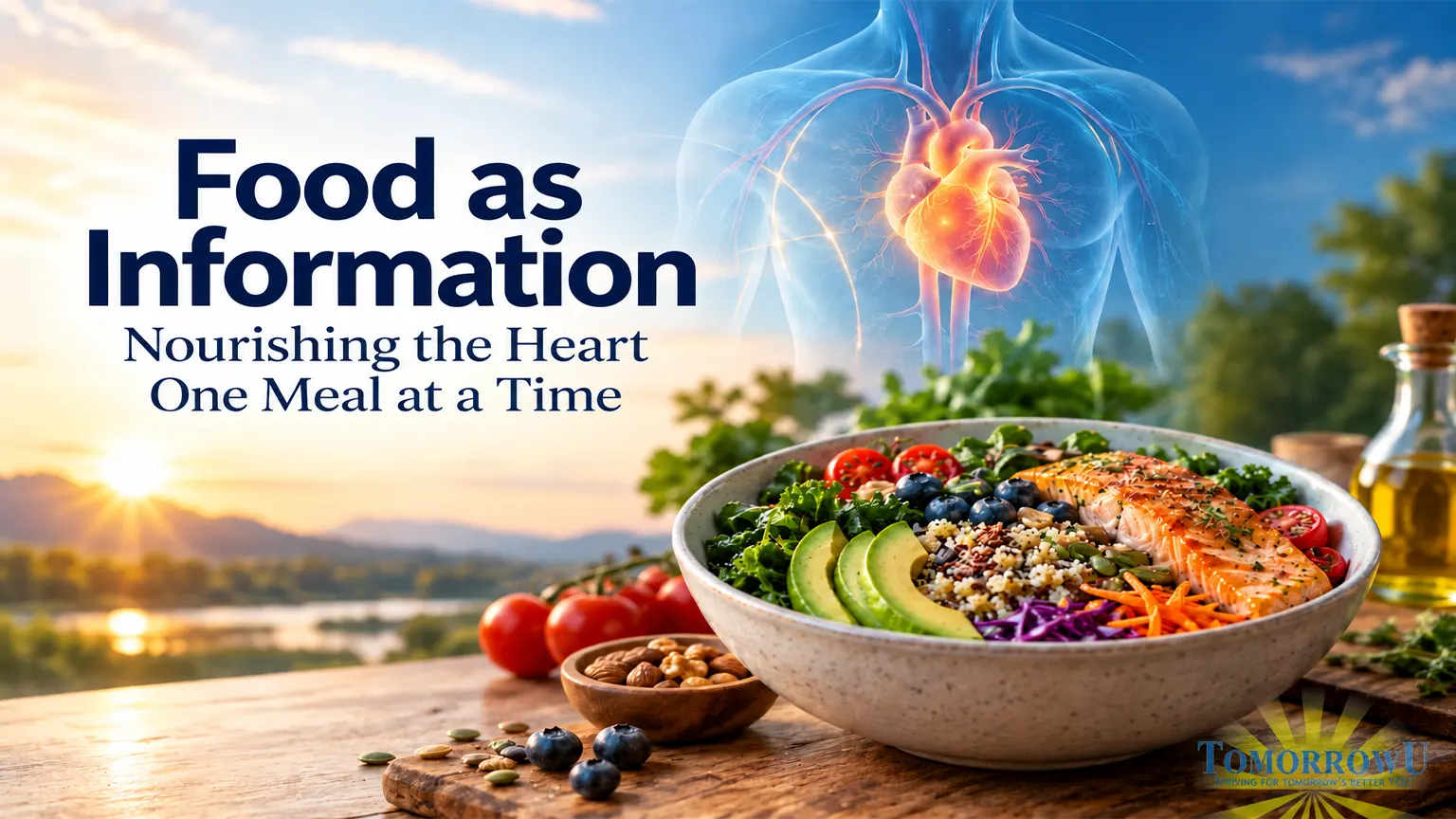
Food is so familiar that it is easy to reduce it to a few simple ideas. Calories give us energy. Protein helps build muscle. Fat gets stored. Carbohydrates become glucose. We eat when we are hungry and stop when we have had enough.
All of that matters, but it leaves out something more fundamental.
The body does not simply receive food. It responds to it.
From the moment a meal begins to be digested, nutrients and other compounds enter an ongoing conversation with the digestive system, liver, muscles, blood vessels, immune system, gut microbes, and brain. Hormones change. Blood flow shifts. Cells take up nutrients, store them, release them, or use them to build and repair. Some signals last only a few hours. Others, when repeated often enough, can gradually influence the conditions in which the body operates.
Food, then, is more than fuel. It is also information.
Understanding food this way changes the question from How many calories does this contain? to something broader: What does this meal ask the body to do?
Every meal is more than fuel. It becomes part of the information shaping how the body responds.
The Language the Body Understands
A meal may look like one thing on a plate, but the body encounters it as a complex mixture of nutrients and compounds.
Carbohydrates can provide glucose that cells use for energy. Protein supplies amino acids needed to maintain muscle, enzymes, immune components, and countless structures throughout the body. Dietary fats provide energy and essential fatty acids while contributing to cell membranes and the production of signaling molecules. Vitamins and minerals participate in reactions that allow these processes to happen.
Fiber behaves differently. Much of it escapes digestion in the small intestine and continues into the colon, where certain fibers become food for gut microbes. Those microbes can transform them into compounds, including short-chain fatty acids, that interact with intestinal cells and influence processes beyond the digestive tract.
Plants contribute still another layer. Fruits, vegetables, legumes, whole grains, herbs, spices, nuts, and seeds contain numerous bioactive compounds, including polyphenols. These substances are not simply calories or traditional nutrients. They can interact with enzymes, microbes, blood vessels, and cellular signaling pathways.
The body therefore does not read a meal as a calorie number printed on a package. It encounters a collection of signals arriving together.
And context matters.
One hundred calories from a fiber-rich food do not necessarily create the same digestive experience, hormonal response, fullness, or nutrient exposure as one hundred calories from a highly refined food. Energy still matters, but calories alone cannot describe everything the body experiences after eating.
The Body Reads Every Meal
In The Body’s Energy Economy, we explored how glucose, glycogen, fat, muscle, and mitochondria participate in the constant movement of energy through the body. In Insulin Resistance, we looked more closely at what can happen when one of the signals coordinating that movement must become progressively louder.
Food is one of the places those conversations begin.
After a meal containing carbohydrate, glucose entering the bloodstream can stimulate insulin. Amino acids from protein create their own hormonal and metabolic responses. Dietary fats are packaged and transported through the circulation. The digestive tract releases hormones that communicate with the pancreas and brain about incoming nutrients, appetite, and fullness.
None of these responses is inherently a problem. They are part of normal physiology.
What matters increasingly over time is the pattern.
A body repeatedly receiving more energy than it needs has to manage that excess. A body repeatedly receiving rapidly digested, low-fiber foods encounters a different nutritional pattern from one regularly receiving foods that arrive with fiber, protein, unsaturated fats, and micronutrients. A body receiving enough protein alongside regular movement has different resources for maintaining muscle than one that does not.
The important story is rarely one meal.
It is what the body is repeatedly being asked to manage.
Why the Heart Is Part of the Conversation
We often talk about food and heart health as though certain foods simply belong on a “good” list and others belong on a “bad” one.
The relationship is more interesting than that.
The heart works inside an environment shaped partly by metabolism. The blood it receives carries glucose, triglycerides, cholesterol-containing particles, hormones, nutrients, and signaling molecules. The vessels through which that blood travels continually respond to pressure, metabolic conditions, nervous system activity, and inflammatory signals.
What we eat can influence many of those conditions.
Dietary patterns rich in vegetables, fruits, legumes, whole grains, nuts, seeds, fish, and other minimally processed foods are consistently associated with better cardiovascular outcomes. Their value does not come from one magical ingredient. Such patterns tend to provide fiber, unsaturated fats, minerals, vitamins, and numerous plant compounds while reducing reliance on foods high in refined starches, added sugars, sodium, and other features common to many ultra-processed products.
Omega-3 fatty acids provide one example of how food becomes part of physiology. Certain omega-3s are incorporated into cell membranes and participate in signaling processes relevant to cardiovascular function. Fiber offers another example: some types can help moderate the rise in blood glucose after eating, contribute to lower LDL cholesterol, and provide substrates for microbial metabolism.
The meal eventually disappears from the plate.
Its biological effects do not disappear with it.
Why Food Structure Matters
Two foods can contain similar amounts of carbohydrate and still be handled differently.
Consider an intact grain and a product made from finely milled flour. Grinding changes the physical structure of the food. Cooking, refining, adding sugars, removing fiber, and combining ingredients can change how quickly nutrients become available during digestion.
This does not mean processing is automatically harmful. Cooking is processing. Freezing is processing. Fermentation is processing. Canned beans, frozen vegetables, yogurt, and whole-grain bread can all contribute to nourishing dietary patterns.
The more useful distinction is what processing has done to the food.
Has it preserved much of the original structure and nutritional value? Or has it created something that is easy to consume quickly, digests rapidly, and provides little fiber or lasting fullness?
This is one reason ultra-processed foods deserve attention without being turned into villains. Many are formulated for convenience, shelf life, texture, and palatability, and some can be eaten quickly while providing less fiber and being less filling than the minimally processed foods they replace.
The issue is not that one packaged snack somehow damages metabolism.
It is that repeated patterns become repeated instructions.
The body remembers the patterns we repeat far more than the meals we occasionally celebrate.
Protein, Muscle, and the Metabolic Reserve We Carry
Protein matters for reasons that extend beyond fitness. The amino acids released during digestion help maintain and repair tissues throughout the body, including muscle.
Muscle is not merely something that moves us. It is also an important site for glucose disposal and energy use. Preserving it therefore contributes to the metabolic story we have already been following.
Food provides the raw materials. Movement provides a reason for the body to maintain and strengthen muscle.
Protein can also contribute to fullness, helping meals remain satisfying without requiring constant attention to calorie counting. This does not mean that more is always better or that every meal needs to revolve around protein. Adequacy matters more than excess.
This relationship between food and muscle also prepares us for another conversation ahead: movement itself is information.
Fiber Connects More Than Digestion
Fiber may be one of the clearest examples of why nutrition cannot be reduced to calories.
It can slow digestion and help moderate glucose absorption. Certain soluble fibers can reduce LDL cholesterol. Fiber contributes to fullness and bowel function. And when fermentable fibers reach the colon, microbes can use them to produce metabolites that interact with the intestinal lining and other parts of the body.
In other words, part of what we eat feeds organisms that then produce signals of their own.
That relationship will deserve a Wellness Insight of its own when we explore the gut and heart more closely. For now, the important point is simpler: a meal communicates not only through what our own digestive enzymes extract from it, but also through what our microbial partners can make from what remains.
A bean, berry, oat, lentil, vegetable, nut, or seed therefore brings more to the conversation than its calorie count suggests.
Building Meals That Communicate Clearly
Once food is understood as information, healthy eating does not require turning every meal into a biochemical calculation.
It can become simpler.
A useful meal often begins with recognizable foods rather than nutritional perfection. A source of protein can provide amino acids and support fullness. Vegetables, fruits, legumes, or whole grains can contribute fiber and a broad range of plant compounds. Nuts, seeds, fish, olive oil, avocado, and other sources of predominantly unsaturated fats can contribute fats that support cardiovascular health.
Variety matters because no single food provides everything the body needs.
Color can be useful too, not because colorful meals possess some special wellness property, but because different plant foods contain different combinations of nutrients and phytochemicals. Eating across that diversity broadens what reaches the body and the microbes that share our internal environment.
Food labels can help, but they need not become a source of anxiety. Looking at added sugars, sodium, fiber, protein, and the ingredient list can provide context. The goal is not to find a flawless product. It is to understand what we are choosing often enough for it to become part of our pattern.
The same principle applies to foods eaten simply because they bring pleasure.
A birthday cake is not a metabolic failure. A restaurant meal does not erase a week of nourishing choices. Food also carries culture, memory, celebration, comfort, and connection.
Health is shaped much more by what happens repeatedly than by what happens occasionally.
That distinction matters because fear is a poor foundation for nourishment.
The Signals We Repeat Become Biology
One meal rarely determines the direction of our health.
But meals are repeated thousands of times.
With repetition, small signals become patterns. Patterns create conditions. And the body adapts to the conditions it encounters most often.
This is the deeper meaning of food as information.
A meal containing fiber, protein, minimally processed plants, and unsaturated fats does not “heal” the body in a single sitting. Nor does an occasional highly processed meal undo health. What matters is the accumulated conversation.
The same principle appeared when we explored visceral fat, energy regulation, and insulin resistance. The body responds to what it encounters repeatedly. Food is one of those recurring inputs, but it does not act alone. Movement changes how nutrients are used. Sleep influences appetite and glucose regulation. Stress can alter eating behavior and metabolic responses. The gut transforms parts of our food into additional signals.
These are not separate stories.
They are different parts of the same conversation.
What we eat matters, but what we repeatedly ask the body to do with it matters too.
Wellness Wrap-Up
Food does not need to become another part of life we attempt to control perfectly. It can instead become something we understand more clearly. Every meal brings energy, building materials, and biological information into a body already responding to movement, sleep, stress, relationships, environment, and everything that came before. The goal is not a perfect plate, but a pattern that provides more of what supports regulation, repair, and cardiovascular health while leaving room for culture, pleasure, and ordinary life. When we begin seeing food not simply as calories to count but as one of the ways our choices interact with our biology, everyday meals take on a different meaning. Understanding those interactions gives us another opportunity to make thoughtful choices today while striving for tomorrow’s better YOU!
References
- Cai, M., Dou, B., Pugh, J. E., Lett, A. M., & Frost, G. S. (2021). The impact of starchy food structure on postprandial glycemic response and appetite: A systematic review with meta-analysis of randomized crossover trials. The American Journal of Clinical Nutrition, 114(2), 472–487. https://doi.org/10.1093/ajcn/nqab098
- Fan, S., Tu, Z., Zhang, Z., Fu, L., Shen, N., & Xiao, X. (2026). Dietary fibers as drivers of short-chain fatty acids homeostasis: A review of intestinal production, systemic distribution, and inter-individual variation. Journal of Agricultural and Food Chemistry, 74(11), 8948–8970. https://doi.org/10.1021/acs.jafc.5c12022
- Ghavami, A., Ziaei, R., Talebi, S., Barghchi, H., Nattagh-Eshtivani, E., Moradi, S., Rahbarinejad, P., Mohammadi, H., Ghasemi-Tehrani, H., Marx, W., & Askari, G. (2023). Soluble fiber supplementation and serum lipid profile: A systematic review and dose-response meta-analysis of randomized controlled trials. Advances in Nutrition, 14(3), 465–474. https://doi.org/10.1016/j.advnut.2023.01.005
- Grosso, G., Godos, J., Currenti, W., Micek, A., Falzone, L., Libra, M., Giampieri, F., Forbes-Hernández, T. Y., Quiles, J. L., Battino, M., La Vignera, S., & Galvano, F. (2022). The effect of dietary polyphenols on vascular health and hypertension: Current evidence and mechanisms of action. Nutrients, 14(3), 545. https://doi.org/10.3390/nu14030545
- Hall, K. D., Ayuketah, A., Brychta, R., Cai, H., Cassimatis, T., Chen, K. Y., Chung, S. T., Costa, E., Courville, A., Darcey, V., Fletcher, L. A., Forde, C. G., Gharib, A. M., Guo, J., Howard, R., Joseph, P. V., McGehee, S., Ouwerkerk, R., Raisinger, K., … Zhou, M. (2019). Ultra-processed diets cause excess calorie intake and weight gain: An inpatient randomized controlled trial of ad libitum food intake. Cell Metabolism, 30(1), 67–77.e3. https://doi.org/10.1016/j.cmet.2019.05.008
- Lichtenstein, A. H., Appel, L. J., Vadiveloo, M., Hu, F. B., Kris-Etherton, P. M., Rebholz, C. M., Sacks, F. M., Thorndike, A. N., Van Horn, L., & Wylie-Rosett, J. (2021). 2021 dietary guidance to improve cardiovascular health: A scientific statement from the American Heart Association. Circulation, 144(23), e472–e487. https://doi.org/10.1161/CIR.0000000000001031
- Sherratt, S. C. R., Libby, P., Bhatt, D. L., & Mason, R. P. (2022). A biological rationale for the disparate effects of omega-3 fatty acids on cardiovascular disease outcomes. Prostaglandins, Leukotrienes and Essential Fatty Acids, 182, 102450. https://doi.org/10.1016/j.plefa.2022.102450
- Tagawa, R., Watanabe, D., Ito, K., Ueda, K., Nakayama, K., Sanbongi, C., & Miyachi, M. (2021). Dose-response relationship between protein intake and muscle mass increase: A systematic review and meta-analysis of randomized controlled trials. Nutrition Reviews, 79(1), 66–75. https://doi.org/10.1093/nutrit/nuaa104
Note: Always consult with a healthcare professional before making significant changes, especially if you have existing health conditions.